

If someone searches “bakery near me” right now, does your business show up? For most small business owners, the honest answer is “I am not sure.” You built a website, you may have a Google listing, but you still do not know if nearby customers can actually find you. This gap between having a business online and being found online is exactly what local SEO fixes.
Quick Answer
Local SEO is the practice of making your business easy to find when nearby people search for what you sell. It means Google, Bing, and AI tools show your name, address, and phone number to the right person at the right moment. ADryft.in, a digital marketing team based in Manikonda, Hyderabad, works with small businesses on exactly this problem every day. Local SEO combines your Google Business Profile, your website, your reviews, and consistent business information across the internet, so search engines trust your business enough to recommend it.
What Is Local SEO and How Does It Work?
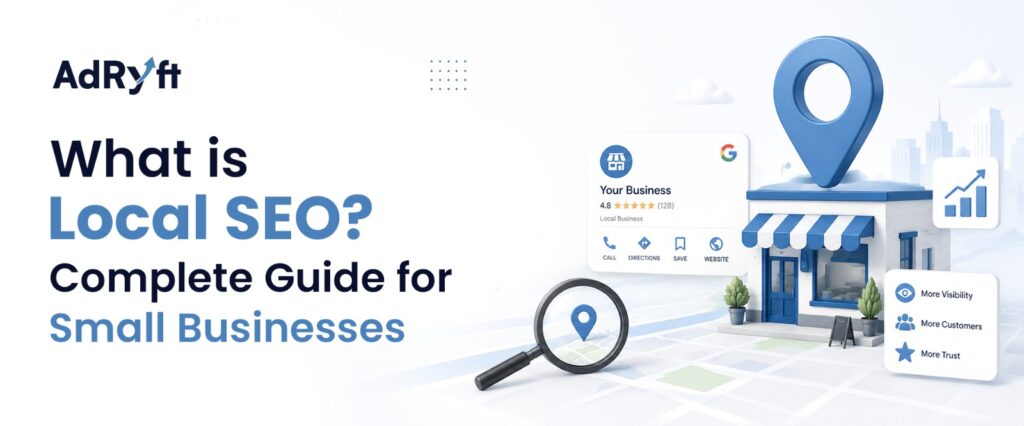
Local SEO stands for local search engine optimization. It helps your business appear when someone searches for a product or service near a specific place. A user typing “plumber in Manikonda” is showing local intent, and Google’s job is to match that search with real businesses nearby.
Local SEO works through a mix of signals. Google reads your business information, checks how close you are to the searcher, and looks at how trusted your business appears online. Google Business Profile Help confirms that inaccurate business info can keep a listing from showing up for relevant local searches. That single point explains why so many small businesses stay invisible even after building a website. The fix is simple. Keep your business name, address, phone number, hours, and category correct everywhere they appear online.
How Is Local SEO Different From Regular SEO?
Regular SEO tries to rank a website for anyone searching a keyword, anywhere in the world. Local SEO narrows that goal to people searching near a specific city, neighborhood, or service area. A national ecommerce brand needs regular SEO. A dentist, salon, or restaurant needs local SEO first.
The table below breaks down the main differences in plain terms.
| Factor | Regular SEO | Local SEO |
| Main goal | Rank nationally or globally | Rank for nearby searches |
| Key tool | Website content and backlinks | Google Business Profile and NAP data |
| Competition | Large, often global brands | Nearby businesses in the same area |
| Search example | best running shoes | running shoe store in Manikonda |
| Where results show | Organic search list | Map pack, Maps, and local search results |
Both approaches use similar basics like good content and technical health, but local SEO adds location signals that regular SEO does not need.
Why Does Local SEO Matter for Small Businesses?
Local SEO matters because most customers now research a business online before they ever walk in. India alone shows how big this shift has become. India had 1.03 billion internet users by the end of 2025, with internet penetration at 70 percent of the population, according to DataReportal. That is a massive pool of people searching for local shops, clinics, and services every single day.
For a small business, local SEO levels the playing field. You are not competing with every business in the country. You are competing with the handful of businesses near you, using local keyword research and a clear local SEO strategy instead of a national budget. A well-optimized local presence can beat a bigger brand simply because it answers the searcher’s need for something close, open, and trustworthy right now. Skipping local SEO does not mean standing still either, since competitors nearby are actively filling that gap while you wait.
What Actually Helps a Business Rank Higher in Local Search?
Google keeps its full ranking system private, but it has confirmed the three core factors that decide local search ranking and Map Pack placement.
Relevance, Distance, and Prominence Explained Simply
Relevance means how well your business matches what someone searched for. A complete, detailed profile helps Google understand exactly what you offer. Distance means how close your business is to the person searching, or to the location they typed. Prominence means how well known and trusted your business appears, based on reviews, mentions, and overall reputation. Google Business Profile Help explains that local results are mainly based on relevance, distance, and popularity, and together these factors help Google find the best match for a customer’s search.
You cannot control distance, since that depends on where the customer is standing or searching from. But you have full control over relevance and prominence. Better categories, clearer service descriptions, and steady reviews all push those two factors in your favor.
Smaller signals support these three main factors too. Google looks at how consistent your name, address, and phone number are across the web, a practice known as NAP consistency. It also looks at local citations on directories, how often people click your listing, request directions, or call you directly from search results. None of these smaller signals work alone, but together they build the kind of online reputation that pushes a listing higher in Google Maps over time. If you want a full breakdown of where your business currently stands, our local SEO services team can run a quick check across all these signals.
How Do You Set Up and Optimize a Google Business Profile?
Your Google Business Profile, often shortened to GBP, is the single most important free tool in local SEO. It is the business listing that shows up on Google Maps and in local search results, complete with your hours, photos, reviews, and contact details. Think of it as your main local directory entry, the one Google trusts the most.
What Information Should You Include in Your Profile?
Start with your exact business name, a correct address, and a working phone number. Choose the most specific category that matches your core business, then add secondary categories only if they genuinely apply. Fill in your hours, add real photos of your location and work, and write a clear description of what you do, without stuffing it with keywords. Keep every detail consistent with your website and other online listings.
This effort pays off directly. HubSpot reports that customers are 70 percent more likely to visit and 50 percent more likely to consider purchasing from businesses with a complete Business Profile. A half-finished profile quietly costs you customers who never even knew you existed.
Once your profile is live, treat it as an ongoing task, not a one-time setup. Add fresh photos when you can, update your hours around holidays, and reply to every review, good or bad. A calm, professional reply to a negative review often builds more trust with future customers than a long list of five-star ratings alone. If setup and upkeep feel like too much on your own, our Google Business Profile optimization service handles this for you month to month.
How Does Local SEO Show Up in Google AI Mode, ChatGPT, and Perplexity Answers?
Search behavior has changed. People do not just type keywords anymore. They ask full questions and expect a direct answer, whether they are using Google AI Overviews, ChatGPT, Gemini, or Perplexity. This shift matters for local SEO in a very specific way.
Not every local query behaves the same way inside AI search. Search Engine Journal’s research across real search results found that queries beginning with question words like how, why, or what triggered AI Overviews 28 percent of the time, while near me style queries triggered the Maps Pack instead, almost every time. In other words, informational questions tend to pull an AI-written summary, while direct local searches still pull the map listing.
People are now asking AI tools questions that go beyond a simple search box. Is local SEO worth it for a small shop? Does ChatGPT use Google Business Profile data when it recommends a business? Can local SEO help a business without a website? These conversational questions are becoming just as common as typed keywords, and the answer to all three is generally yes. AI tools do pull from your Google Business Profile, your reviews, and your website content when they build a local recommendation, so keeping that information accurate and current matters more now, not less.
This means your local SEO strategy now needs two layers. Keep your Google Business Profile strong for direct, transactional searches like “near me.” At the same time, publish simple, well-structured answers to common questions your customers ask, since that is the content AI tools pull from when they build an answer. Clear headings, short paragraphs, structured data on your website, and direct answers near the top of the page help both regular search engines and AI tools understand and quote your content correctly. This broader approach is often called entity SEO, since it focuses on helping search engines understand exactly who your business is, not just which keywords your page contains. Voice search assistants rely on the same clean, structured data, so the work supports both typed and spoken local searches at once.
A few technical additions strengthen this further. Adding LocalBusiness schema to your website tells search engines your name, address, hours, and category in a format machines read instantly. Review schema does the same for your star ratings, so they can appear directly in search results. If you serve more than one neighborhood or city, dedicated service area or location pages, each with real local detail rather than duplicated text, give both Google and AI tools more specific content to match against local searches.
Why Do Small Businesses Fail at Local SEO Even After Creating a Website?
Many small businesses lose visibility through mistakes that are easy to avoid. Inconsistent business details across the web confuse both customers and search engines. Ignoring customer reviews, or never responding to them, quietly damages online reputation. Choosing a broad or incorrect business category weakens relevance. Publishing generic content that could apply to any city, instead of writing for your actual local audience, makes it harder to stand out and lowers organic traffic over time.
A slow, hard-to-use website on mobile devices also hurts rankings, since most local search now happens on mobile search. Fixing these issues does not require a large budget. It requires consistency, patience, and a habit of checking your online presence regularly instead of setting it up once and forgetting about it.
Another mistake worth naming is treating local SEO as a single project with an end date. Search engines and AI tools both reward businesses that stay active. A profile updated last year looks less trustworthy than one updated last week, even if the underlying business has not changed at all.
It also helps to know whether your effort is actually working. Track the number of calls, direction requests, and website clicks coming from your Google Business Profile Insights each month. Watch your keyword rankings for local search terms, and keep an eye on how many of those visits turn into real customers. A technical SEO audit once or twice a year is a simple way to catch small problems before they cost you rankings.
Article Pros and Cons
- Local SEO costs little to nothing to start. Your Google Business Profile is free to claim and manage, so you can begin improving visibility before spending on ads or agencies.
- It targets people who are ready to buy or visit soon. This usually leads to higher quality leads than broad advertising, since the searcher already has local intent.
- Results take time to build. Most businesses see meaningful movement over a few months, not a few days, so patience matters as much as setup.
- Reviews and reputation carry real weight. One period of poor service can slow your progress even with a technically strong profile, since prominence depends partly on trust signals.
- Local SEO cannot fully replace other marketing. It works best alongside a decent website and consistent customer service, not as a standalone fix for a struggling business.
- Competitive cities or crowded categories may need sustained effort. Businesses in dense markets like restaurants or salons often need several months of consistent work before reaching the top local results.
Frequently Asked Questions
Q: Is local SEO free?
A: The core tools, like Google Business Profile, are free to use. You can improve rankings without paying for ads. Some businesses choose to hire help for faster results, but the basics cost only time and consistent effort, not money.
Q: How long does local SEO take to show results?
A: Most small businesses start noticing changes within two to four months. Full results, like steady map pack visibility, often take four to eight months, depending on competition, profile completeness, and how consistently you keep improving your listing.
Q: Do I need a website for local SEO to work?
A: A website is not always required to appear on Google Maps, but it helps a lot. It gives customers more detail, builds trust, and gives search engines more content to understand your business and match it to searches.
Q: What is the difference between local SEO and Google Ads?
A: Local SEO builds visibility organically over time and does not require ongoing payment per click. Google Ads shows your business instantly but stops the moment you stop paying. Many businesses use both together for faster and longer lasting results.
Q: Can a home-based business use local SEO?
A: Yes. Home-based and service-area businesses can hide their exact address while still listing a service area on their Google Business Profile. This lets you appear in local searches without publishing your home address publicly.
Q: How often should I update my Google Business Profile?
A: Check it at least once a month. Update hours around holidays, add new photos when you can, and reply to reviews as they come in. AI tools and Google both treat an actively managed profile as more trustworthy than one left untouched for months.
Q: Does AI use reviews when recommending a local business?
A: Yes. AI Overviews and chat assistants often weigh review count, rating, and recency alongside your Google Business Profile details. A steady stream of recent, genuine reviews improves your chances of being the business an AI tool actually names.
How ADryft.in Helps Small Businesses Get Found Locally
Understanding local SEO is one thing. Managing it consistently, month after month, is where most small business owners run out of time. ADryft.in, based in Manikonda, Hyderabad, works with small businesses that want steady, honest local visibility instead of quick tricks that fade. The approach stays simple: complete profiles, consistent business information, real reviews, and content that actually answers what local customers are asking. No inflated promises, just steady groundwork that search engines and AI tools both trust over time.
If you are unsure where your business currently stands in local search, a short conversation is often enough to spot the biggest gaps.
Ready to see where your business stands in local search? Book a free consultation with ADryft.in today.

Leave a Reply